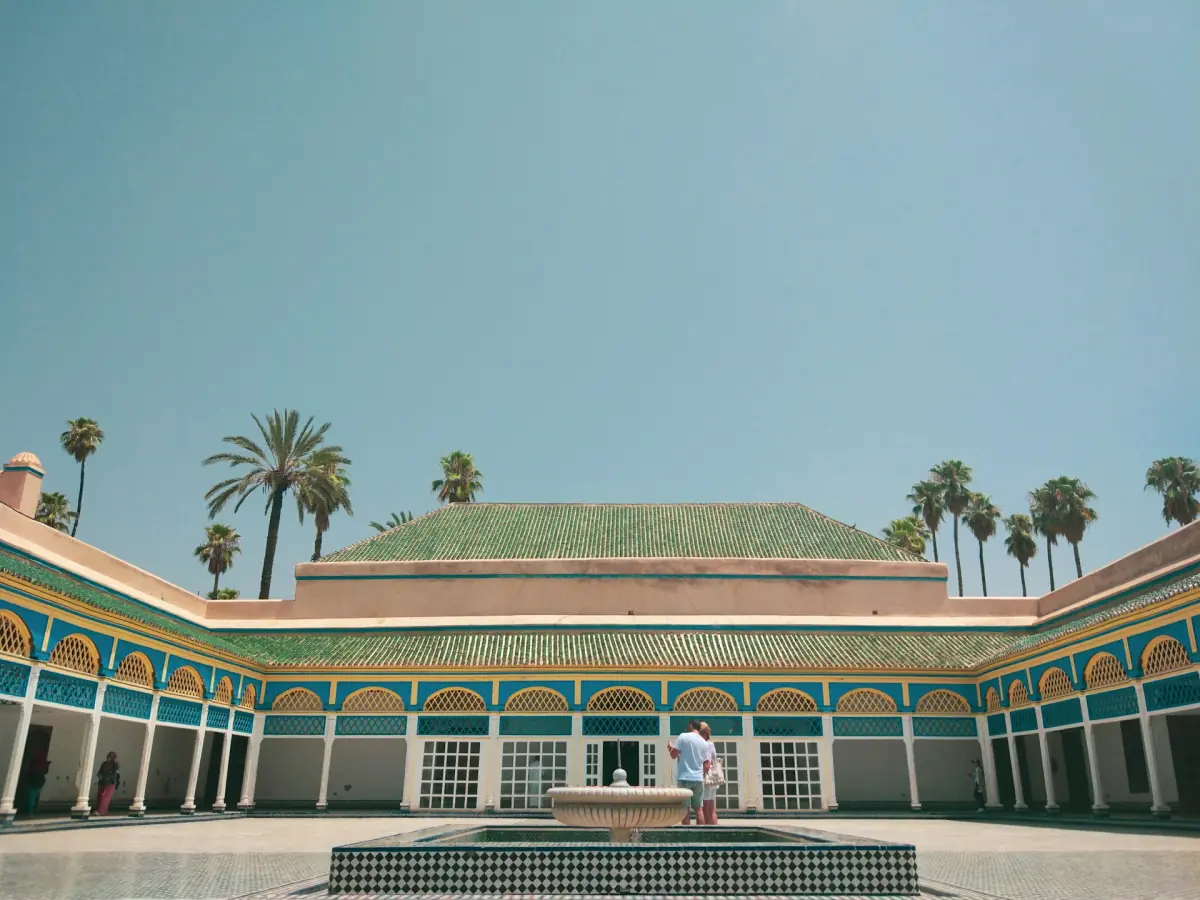
Understanding Bahia Palace history
Bahia Palace history starts with its foundation by Si Moussa in 1866 and the enlargement undertaken by his son Ba Hmad. That family connection is a useful starting point for a visit: the palace developed through successive building phases, rather than a single unified project. Its courtyards, gardens, salons and outbuildings belong to that evolving complex in Riad Zitoun Jdid, within Marrakech’s Medina.
Begin with the people and then look at the spaces around you. The Riad Si Moussa, Petit Riad and Salle d’honneur provide names to connect with the building’s history. For a closer look at surfaces and craftsmanship, turn to the architecture and art guide. This page concentrates on the founders, the wider historic city and the distinction between past conservation work and arrangements for a visit today.

Historic Marrakech walks
Choose the three-monument walk for historical explanations, or the Kasbah route for a walk through the Mellah. Entry tickets cost extra.
Hand-picked tours, booked through GetYourGuide. Prices are indicative starting prices in euros (as of October 2026). Tap a tour for live availability and the current price in your currency.

Bahia, El Badi and Saadian Tombs walk
- Licensed local tour guide
- Historical and cultural explanations
The guide assists with ticket purchases where permitted; entry tickets are paid separately.
Check availability →
Bahia and historic Marrakech walk
- Licensed local tour guide
- Free time at monuments
Choose a private or small-group walk. Monument tickets are extra.
Check availability →
Bahia, El Badi and Kasbah walk
- Licensed local guide
- Chilled bottled water
Palace entries are extra and payable in cash. The Saadian Tombs stop is outside for photos.
Check availability →Historic monument walks with a guide
Explore Bahia with a local guide, with different monument combinations and entrance tickets paid separately.
Si Moussa, Ba Hmad and the Alaouite setting
Si Moussa and Ba Hmad place Bahia in the Alaouite chapter of Marrakech’s history. The firm chronological anchor is the foundation in 1866, followed by the son’s expansion. Read the palace as a place that grew through the work of these successive patrons. That approach makes more sense than trying to attach every courtyard and decorative surface to one overall construction period.
It also helps to separate the palace’s story from the founding of Marrakech itself. UNESCO places the city’s Almoravid beginnings in 1070 to 1072 and describes its later role as an Almohad capital. Bahia is a much younger monument within that long urban history. A walk through the Medina therefore brings together places from different periods, even when they sit close to one another on a modern visitor’s route.
A palace within the Medina
The Medina was inscribed on the UNESCO World Heritage List in 1985. Bahia belongs to the historic fabric described within that inscription, alongside walls, gates, gardens and other monuments. Its heritage context is the Medina as a whole. Looking beyond the palace boundary helps connect a richly decorated residence with the streets and neighbourhoods around it.
A guided historical walk can make those connections easier to follow. The four-hour monument and souk walk offers a licensed local guide and a private or small-group format, with different monument combinations involving Bahia and Ben Youssef or Le Jardin Secret. Choose the itinerary that matches your interests rather than treating all variants as one cumulative programme. Monument admissions are extra. The tour comparison explains the wider walking-tour choices.
Saadian Tombs and the Kasbah
The Saadian Tombs add a different dynastic setting to a historical walk. Keep the distinction between the Saadian context of those monuments and Bahia’s Alaouite setting in mind. Their inclusion on a shared itinerary is a way to compare chapters of the city’s past, rather than evidence that the sites were created together.
The four-hour Bahia, El Badi and Saadian Tombs walk includes guided visits to all three monuments, with each entrance ticket paid separately. Another four-hour route combines Bahia and El Badi with the Mellah and Kasbah, but its Saadian Tombs stop is outside for photographs. The Koutoubia area is part of that route, without an interior mosque visit. These are different ways to spend a historical walking day; the exterior stop and an interior tombs visit serve different interests.
Conservation after the 2023 earthquake
The earthquake of 8 September 2023 is part of the palace’s recent history. A restoration report dated November 2025 records structural damage, consolidation work and measures for visitor protection. Read that account as a dated record of conservation. For your own visit, obtain current access information separately and allow the available route to determine which spaces you explore.
Historical reading and practical planning work well together: use the ticket guide for admission categories and published visiting hours, then decide whether a monument circuit or a more focused palace visit suits you. El Badi and the Mellah can provide brief neighbouring contexts within a longer guided walk, while Bahia remains the main subject here.
Questions about your visit
Who founded Bahia Palace?
Si Moussa founded the palace in 1866. His son Ba Hmad subsequently enlarged it, creating successive phases within the complex.
Is Bahia a separate UNESCO World Heritage Site?
Bahia forms part of the historic Medina of Marrakech, inscribed in 1985. The palace is included in that wider urban heritage setting.
Are monument tickets included in the historical walks?
The three historical walks featured here charge monument admissions separately. The Bahia, El Badi and Saadian Tombs circuit includes guided visits, while the Mellah and Kasbah route has an exterior photograph stop at the tombs.