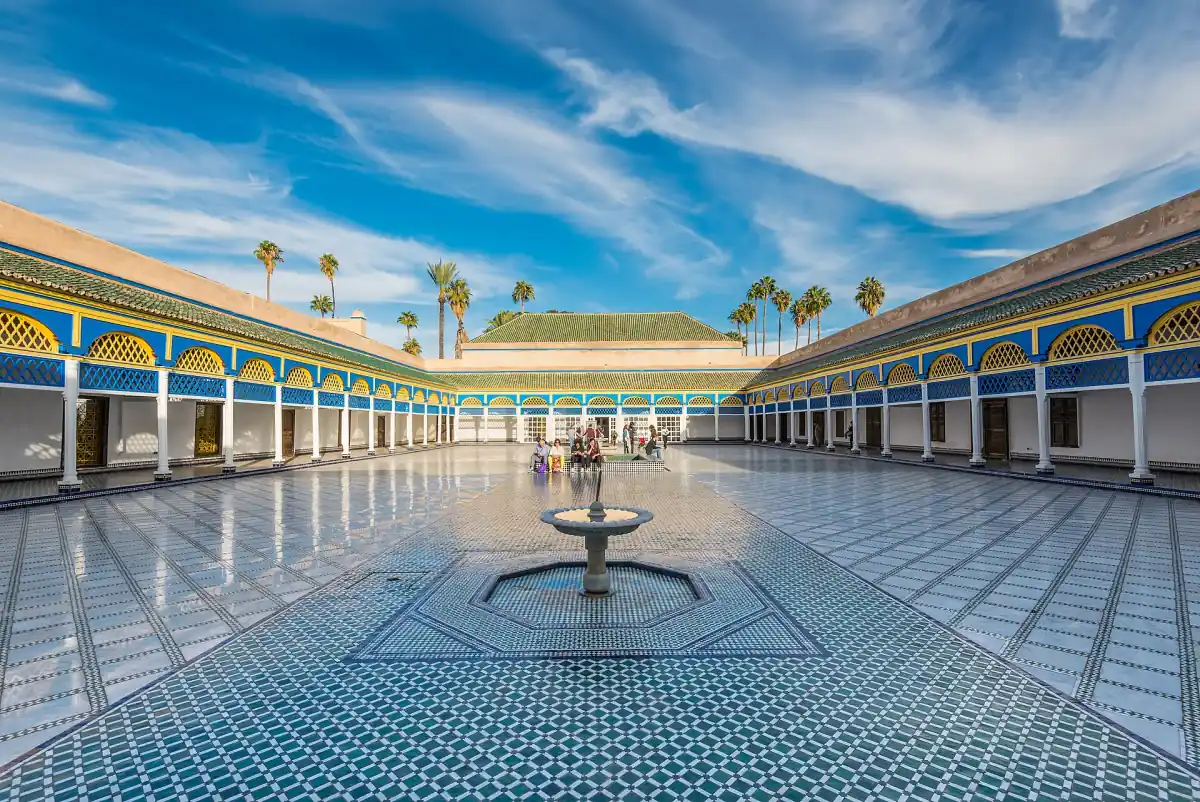
The best time to visit Bahia Palace by season
The best time to visit Bahia Palace for your plans starts with Marrakech’s seasonal weather. Morocco’s tourism office recommends March to May and September to November. Those windows are useful starting points for choosing travel dates, but the months are not interchangeable. September remains hot in the Marrakech climate normals, while the spring and autumn figures change appreciably from one month to the next.
Use the monthly table to compare your likely walking conditions, then choose a time of day separately. A palace visit includes courtyards and gardens as well as rooms, and reaching it can involve a final walk through the Medina. Plan the whole outing rather than treating the palace as a temperature-controlled indoor stop.
For the practical route, see getting to Bahia Palace. If you prefer a guided walk, the tour comparison helps distinguish a palace visit from a longer Medina programme.

Read the Marrakech climate table
The WMO figures below are normals for the Marrakech station covering 1991 to 2020, retrieved on 3 November 2026. Maximum and minimum temperatures are monthly averages of daily highs and lows. Rainfall is the mean monthly total. They describe the climate over that reference period, rather than a forecast for your travel dates or the highest temperature a month can reach.
Compare both temperature columns when planning a day that includes an early start and later outdoor walking. A monthly minimum is not a promised temperature at the palace entrance, just as a monthly maximum does not describe every afternoon. Use the rainfall column to understand the seasonal pattern, then consult the weather forecast nearer your visit for the actual day.
A walk through historic Marrakech
This guided walk combines Bahia and El Badi with bottled water included.
Hand-picked tours, booked through GetYourGuide. Prices are indicative starting prices in euros (as of October 2026). Tap a tour for live availability and the current price in your currency.


A guided walk for your chosen day
Bahia, El Badi and the Mellah on a four-hour walking programme, with a local guide and bottled water; monument entry is extra.
| Month | Mean daily maximum °C | Mean daily minimum °C | Mean monthly rainfall mm |
|---|---|---|---|
| January | 19.1 | 5.9 | 25.0 |
| February | 20.7 | 7.6 | 25.7 |
| March | 23.6 | 10.3 | 35.3 |
| April | 25.7 | 12.4 | 26.3 |
| May | 29.4 | 15.2 | 10.3 |
| June | 33.6 | 17.9 | 3.1 |
| July | 37.7 | 20.6 | 2.2 |
| August | 37.4 | 21.1 | 4.7 |
| September | 32.5 | 18.6 | 15.2 |
| October | 28.5 | 15.7 | 19.1 |
| November | 23.1 | 10.7 | 29.8 |
| December | 20.2 | 7.3 | 24.2 |
Spring, summer and autumn choices
March, April and May sit within the tourism office’s recommended spring period. The table shows the progression towards warmer days, so a late-spring itinerary deserves a different approach from an early-spring one. Keep the amount of walking in mind when comparing dates, particularly if the palace is only one stop in your programme.
Summer is described as hot by the tourism office. July and August have high mean daily maxima in the table, and June is also a warm month. If your dates fall in summer, allow the weather to shape the length of an outdoor outing and the number of additional stops you combine with the palace.
September belongs to the recommended autumn window but has a mean daily maximum of 32.5°C. October and November offer different monthly conditions, so the word autumn alone is too broad for choosing a walking itinerary. Winter brings milder daytime conditions and cooler evenings in the tourism office’s description; consider those different parts of the day when organising your plans.
Choosing an early start
The travel guide thebahiapalace.com, updated on 9 October 2026, recommends an early start. Treat that as planning advice rather than a promise of empty courtyards or a particular waiting time. A November 2025 restoration report recorded strong visitor pressure, but the material does not provide an hourly crowd chart to use for precise scheduling.
The published visiting hours are 09:00 to 17:00. Keep this separate from the departure time of a guided tour and read the tickets and opening-hours guide for visit organisation. A tour advertised on a weather page is an option for your itinerary, rather than a reserved early entrance to the palace.
Weather, sun and walking routes
The guided option here is a four-hour walk with Bahia Palace, El Badi and the Mellah, alongside other Medina stops. A licensed local guide and chilled bottled water are included; monument admission and transport are extra. The programme adds outdoor walking to the palace visit, so match the outing to the conditions expected on your chosen day.
Courtyards, gardens and decorated rooms are part of the palace setting. Their presence should guide what you want to see, rather than your expectation of a fully shaded route or a particular indoor temperature. For a shorter day, organise the palace visit first and decide separately how much more walking to add.
Questions before you go
Is September a cooler autumn choice?
September is within the tourism office’s recommended period, but its mean daily maximum is 32.5°C in the 1991 to 2020 Marrakech normals. Account for that heat when planning walking.
Does arriving early guarantee fewer people?
An early start is a recommendation from the travel guide updated on 9 October 2026. Choose it as a planning preference, without relying on a particular crowd level or waiting time.
Is the climate table a forecast?
It contains WMO station normals for 1991 to 2020. Use it to compare seasons, and use a forecast for the weather expected on your actual visit date.