
Looking closely at Bahia Palace architecture
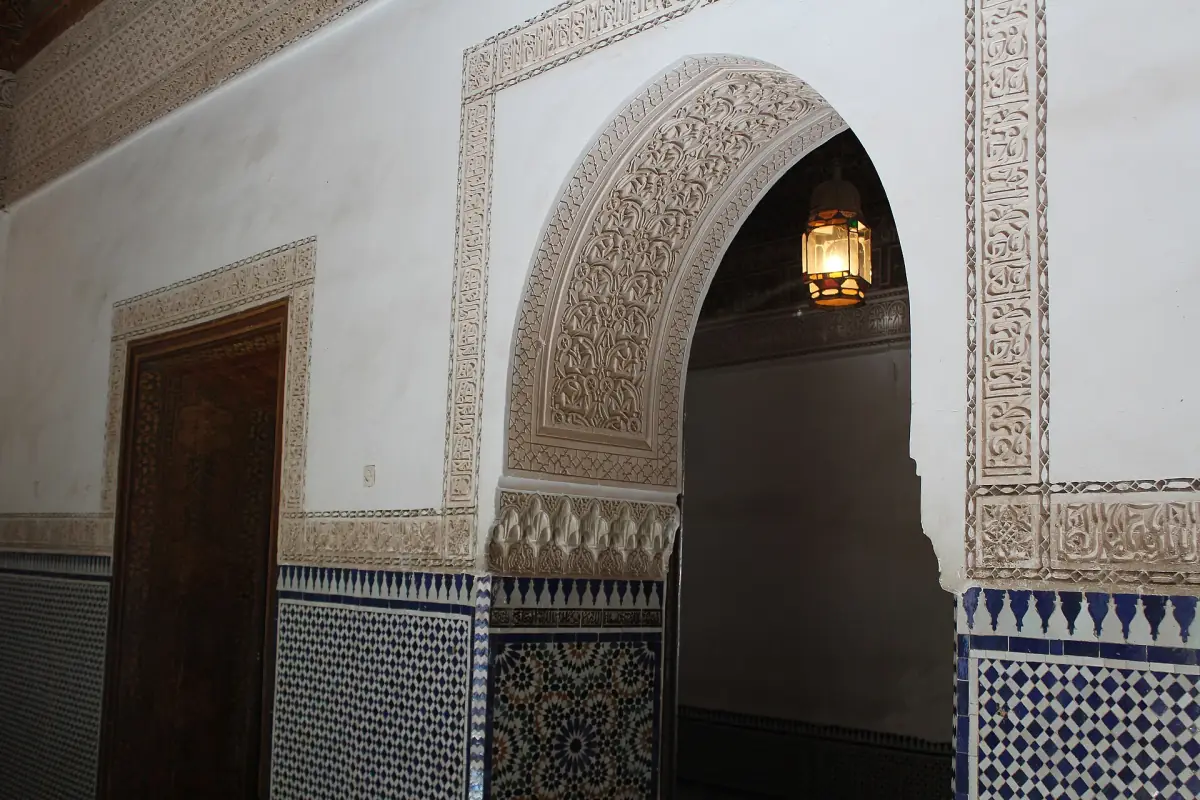
Bahia Palace architecture brings courtyards, gardens, salons and outbuildings into one complex in Marrakech’s Medina. The detail is as important as the overall layout: marble, zellij tilework, stucco, coloured glass and carved or painted wood give you different things to look for. Start with the relationship between an open courtyard and its surrounding decoration, then turn your attention to a doorway, a screen or a ceiling.
The named parts of the complex include the Petit Riad, Riad Si Moussa and Salle d’honneur. Use those names as architectural reference points while following the route available during your visit. The palace was founded by Si Moussa in 1866 and enlarged by his son Ba Hmad; our history guide explains that background. Here the focus is on spaces, materials and the forms of craftsmanship you can look for.

Palace visits with a guide
Choose a Bahia-only visit for time in the palace, or combine Bahia with El Badi and the Mellah. Check the entry option before booking.
Hand-picked tours, booked through GetYourGuide. Prices are indicative starting prices in euros (as of October 2026). Tap a tour for live availability and the current price in your currency.

Bahia, El Badi and Mellah walk
- Licensed local guide
- Visit to the Jewish Quarter
Select the private option for a private guide. Entry to both palaces costs extra.
Check availability →
Guided Bahia Palace visit
- Licensed local tour guide
- Free time to explore
Choose the ticket-inclusive option or pay palace entry separately.
Check availability →
Bahia Palace walking visit
- Licensed local tour guide
- Free time at Bahia Palace
Select the private option for a private guide. Palace entry is extra.
Check availability →Images – Bahia, El Badi and Mellah walk: Crop of a photo by Misa.stefanovic.07 / CC BY-SA 4.0; Guided Bahia Palace visit: Crop of a photo by Adam Harangozó / CC BY-SA 4.0; Bahia Palace walking visit: Crop of a photo by Vassia Atanassova - Spiritia / CC BY-SA 4.0


Guided visits for exploring the palace
A short Bahia visit or a longer walk through Bahia, El Badi and the Mellah, with admission depending on the selected product and option.
Rooms and courtyards
The ministry’s description identifies four main courtyards, with fountains and gardens forming part of their setting. This gives a useful sense of the palace as a group of connected spaces. A courtyard can be approached as a composition: look at its floor, the surrounding openings and the treatment of the surfaces around them. Then compare those broad forms with the more intricate decoration of a room.
The Petit Riad, Riad Si Moussa and Salle d’honneur are among the parts named in the restoration account of November 2025. They offer a vocabulary for understanding the complex, rather than a prescribed order for your walk. Let the route in use on the day guide your progress. You can combine this architectural reading with the practical information on tickets and visiting arrangements, especially when choosing between a guided visit and your own exploration.
Craftsmanship and art in wood, stucco and zellij
Zellij, also written zellige, is one of the palace’s decorative elements, alongside stucco, marble, coloured glass and moucharabieh screens. Look at the different effects of a tiled surface, a carved wooden screen and a painted ceiling. These are distinct materials and techniques within the same architectural setting, so a useful approach is to give each one attention rather than looking only for a panoramic photograph of a courtyard.
The regional tourism board describes tiles from Tétouan, marble from Meknès and cedarwood from the Middle Atlas for painted ceilings. These origins belong to its account of the palace’s materials. They make a helpful background to looking at the craft, while individual repaired surfaces have their own conservation history. The same tourism account names the architect Si Mohamed El Mekki El Mesfioui. Building design and decorative work can therefore be explored together without reducing the palace to a collection of isolated ornaments.
Gardens within the palace
The Bahia Palace garden setting belongs to the same architectural story as the rooms and courtyards. Trees, fountains and decorated façades are elements to consider together. When you enter a garden courtyard, look at how the planted space relates to the building around it. That change of focus provides a natural counterpart to studying a ceiling or a carved doorway.
For a broader craft context, Dar Si Said is associated with Moroccan carpets and weaving, including urban and rural textiles. Keep that as a neighbouring cultural reference rather than an extra stop promised as part of these palace visits. Inside Bahia, follow the spaces available to visitors and give yourself time to observe their materials. The garden photographs illustrate the setting; choose your visit for its route and content.
Choosing the amount of guided walking
A focused Bahia tour lasts 1.5 hours and includes a licensed local guide, with private or small-group options. The version meeting at Café de France charges admission separately; Medina pickup belongs to its private option. Another 1.5-hour Bahia visit starts outside Café Argana and has options with or without entrance tickets. These focused formats suit a day centred on the palace and its decorative details.
The four-hour Bahia, El Badi and Mellah route includes a licensed guide and guided visits to both palaces, with both palace entrance fees extra. It suits visitors who want to place Bahia within a longer old-town walk. These are palace and cultural walking visits; select among them by duration and itinerary. For the distinctions between booking formats, read the private tours guide. Transport is separate from the walking programme.
Questions about your visit
Which materials should I look for?
Look for zellij tiles, marble, stucco, moucharabieh screens, coloured glass and carved or painted wood. Painted cedar ceilings are a particular part of the material story described by the regional tourism board.
How long are the guided visits?
The focused palace visits listed here last 1.5 hours. The Bahia, El Badi and Mellah walk lasts four hours. These are product durations for the guided programmes.
Does a guided visit include admission?
The Café de France palace visit and the longer two-palace walk charge entrance fees separately. The Café Argana palace visit offers a choice with or without entrance tickets; admission is included in the corresponding ticket option.